


Commissioner Ahmet Prençi, Communication With The Media Regarding Findings From The Monitoring Of The October 19, 2026 Protest
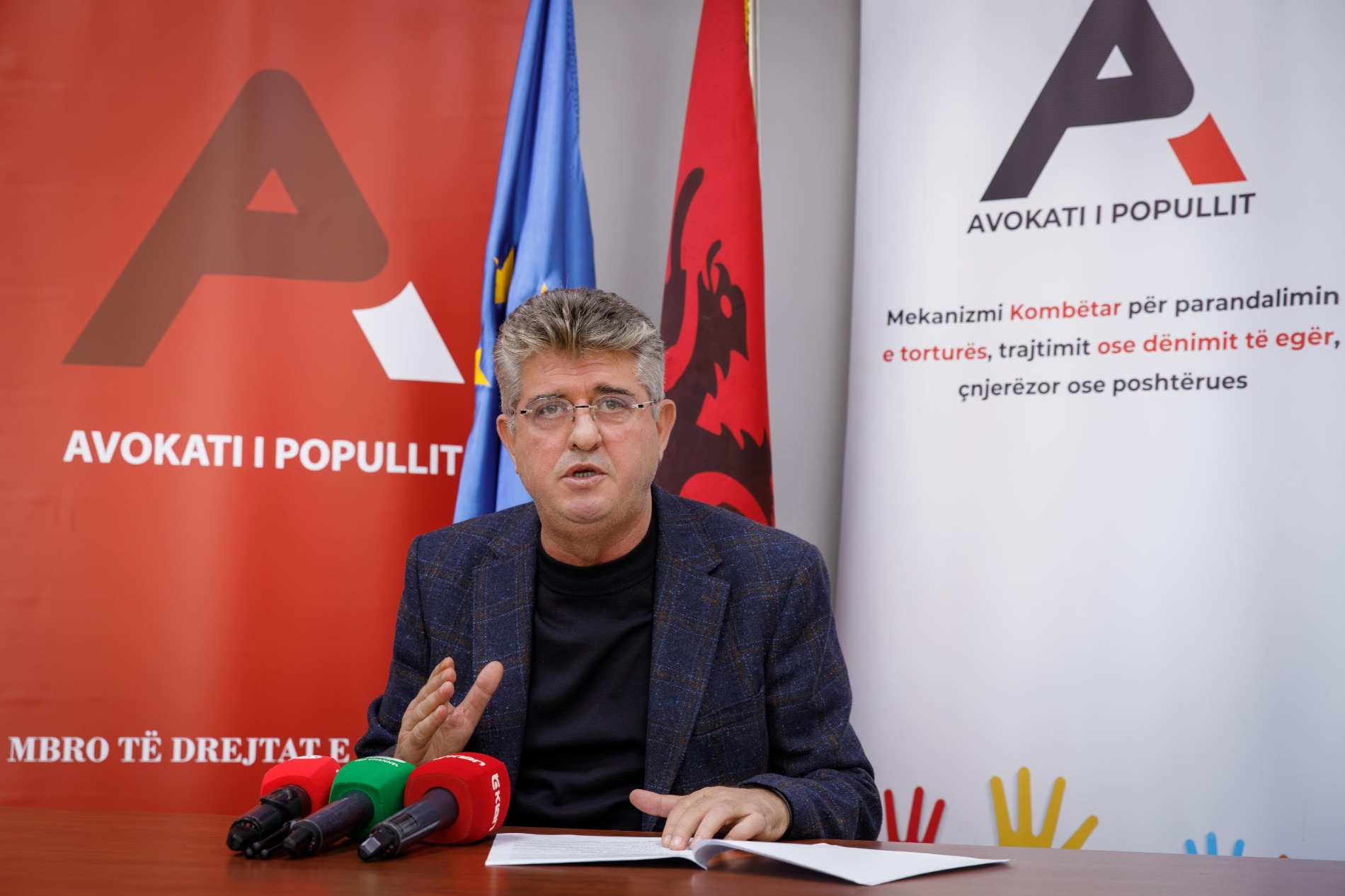
Today, October 20, in my capacity as Commissioner for the National Preventive Mechanism against Torture—a unit within the Office of the Ombudsman—I am providing an update on findings from our monitoring over the last 24 hours regarding the observance of human rights during the protest, as well as the treatment of individuals who were detained or sustained injuries.
These are preliminary findings. A more in-depth investigation is ongoing, and we will provide further updates within the legally mandated timeframes.
Throughout the day on October 19, continuing into late evening, teams from the Office of the Ombudsman inspected Police Stations No. 1, 2, 3, 4, 5, and 6 in Tirana, as well as the Security Block (detention facility) and the Trauma Hospital.
No individuals were reported to have been detained at Police Stations No. 5 and 6; therefore, these locations are not included in this report.
Yesterday, the police detained 50 individuals: 32 adults and 18 minors.
Police Station No. 1: 21 individuals, including 8 minors.
Police Station No. 2: 19 individuals, including 7 minors and 2 women.
Police Station No. 4: 10 individuals, including 3 minors.
Security Block: 109 individuals were held in custody, including 1 minor and 4 women. Trauma Hospital: 34 individuals received medical treatment, including 21 police officers, 7 protesters, and 5 bystanders.
Yesterday, we made contact with 193 individuals—including those detained, arrested, or hospitalized—among whom were 6 women and 19 minors. In total, we processed 11 complaints: 10 concerning the Security Block (detention facility) and one regarding a minor held at Police Station No. 1.
We also received reports via our official telephone line, and several cases were brought to our attention through social media. Based on the information gathered, we have initiated administrative investigations into these instances, where there are allegations of human rights violations.
At Police Station No. 1, five of the eight detained minors alleged that they were subjected to physical and verbal abuse by State Police officers. In two of these cases, we observed signs of physical injury. At the Security Block, we received a complaint regarding the abuse of a minor.
Standard: Article 3 of the European Convention on Human Rights (ECHR) prohibits torture and inhuman or degrading treatment, without exception. Article 37 of the Convention on the Rights of the Child (CRC) mandates humane treatment and respect for the needs of individuals under the age of 18. This is significant because violence against a minor while in custody constitutes an absolute violation, and those responsible must be held accountable in every instance.
Procedural safeguards for minors
At Police Station No. 1, minors were not provided with a form outlining their rights. Following our intervention, a form intended for adults was provided; however, it was outdated. Six minors were recorded in the register for adults. At Police Station No. 4, the register for minors was only partially completed.
Standard: Article 5 of the ECHR requires that any person deprived of their liberty be informed promptly of the reasons for such deprivation and of their rights. Article 37 of the Convention on the Rights of the Child (CRC) mandates that minors be kept separate from adults and have prompt access to legal assistance. The Code of Criminal Procedure and the law on juvenile criminal justice specify the procedures for informing minors and notifying their parents or guardians.
This is important because, in the absence of an accurate form and a separate register, it becomes impossible to prove that these rights have been violated, leaving the minor without the protections guaranteed by law. Violence against adults
Those detained alleged that they were subjected to violence at the time of their apprehension, including the use of pepper spray and tear gas, being struck with a tear gas canister, being dragged along the ground, and experiencing physical and psychological abuse by State Police officers. One complainant alleged that he was struck inside an office at Police Station No. 4, an area not covered by security cameras.
Standard: Article 3 of the ECHR and Article 2 (protection of the right to life). The UN Basic Principles on the Use of Force (1990) require that the use of force be necessary and proportionate. Article 11 of the ECHR protects the right to peaceful assembly; any restrictions must be lawful, necessary, and proportionate.
Inspection of mobile phones
Several minors and adults reported being asked to unlock their mobile phones and permit the inspection of their personal data, without a court order and even in the absence of any charges brought by the prosecution.
Standard: Article 8 of the ECHR protects private life and correspondence. Any interference must have a legal basis and be necessary. The Code of Criminal Procedure stipulates that the search for and seizure of electronic data must be carried out by order of the prosecutor and with the authorization of the court.
This is significant because a search conducted without a legal basis constitutes an interference with private life and an infringement of fundamental human rights.
Detentions without an individual-specific justification
Some complainants state that they were taken to the police station without any lawful reason, as they were merely passersby with no connection to the protest.
Standard: Article 5 of the ECHR permits the deprivation of liberty only on lawful and defined grounds, such as a reasonable suspicion of a criminal offense.
Identification of police officers
At police stations 2 and 4, police officers were observed without identification numbers; furthermore, there were gaps in the data recorded in the detention/escort registers.
Standard: The European Code of Police Ethics (Council of Europe, 2001) and the standards of the European Committee for the Prevention of Torture (CPT) require that police officers be identifiable. Law No. 108/2014 "On the State Police" outlines the obligations of police officers in the performance of their duties.
This is significant because, in the absence of identification, establishing personal accountability for allegations of violence becomes difficult. Moreover, it undermines public trust in the State Police by failing to distinguish those who break the law from those officers who act in compliance with it.
Conditions and capacity
Approximately 109 arrested individuals are held in the Security Unit (detention facility). The overcrowding of the premises is directly linked to a lack of beds, water, heating, and medical care.
Standard: Article 3 of the ECHR (European Convention on Human Rights) and the Strasbourg Court, through its jurisprudence, have established a minimum space requirement of 3 m² per prisoner in multi-occupancy cells. The CPT standards for police detention require the provision of a bed, food, water, hygiene, and medical care.
This is significant because overcrowding is a direct cause of other violations, as it renders the protection of fundamental rights impossible.
In conclusion:
We emphasize that the right to peaceful assembly is guaranteed by the Constitution, and protesters must exercise this right peacefully. We condemn any act of violence, regardless of the perpetrator.
The State Police have an obligation to ensure public safety; however, the use of force must be limited to instances where it is strictly necessary and must be proportionate.
Furthermore, every police officer must be identifiable and held individually accountable for their actions.
Minors are entitled to special safeguards, which may not be disregarded under any circumstances.
Based on our findings thus far, we call upon:
The State Police: to ensure that every officer on duty is identifiable—with a visible identification number—and that all vehicles used in any operation are clearly marked/identifiable. Ministry of the Interior: Take urgent action to address overcrowding at the Security Block by immediately reducing the number of individuals held there and transferring them to other facilities, in accordance with legal capacity limits.
State Police: Ensure the installation of cameras in all holding and interview rooms—including every office—with provisions for the storage of footage; specifically, ensure the immediate preservation of footage from October 19th.
State Police: Prohibit the inspection of mobile phones without a court order, and forbid any requests for passwords that lack a legal basis.
State Police: Ensure the presence of a parent or guardian, as well as a psychologist, during any interview involving a minor; provide a child-friendly version of the "statement of rights" form prior to any questioning; and maintain a separate register for minors.
State Police: Implement ongoing training regarding the proportionate use of force and tear gas.
State Police: Ensure that detention/holding registers are fully completed with all required data.
Ministry of Health and State Police: Ensure that medical personnel are available at all times within holding facilities, and that any injuries are medically documented in accordance with the Istanbul Protocol. The Ombudsman will monitor the implementation of these requirements, and any instance of abuse is being investigated—primarily on the Ombudsman’s own initiative.
We invite any citizen whose rights have been violated by the State Police to submit an individual complaint to us—via our telephone numbers, our official website, or our social media channels.
Confidentiality is guaranteed.
Thank you.