

Ombudsman: Public Order Is The Responsibility Of The State, Not Of Private Companies
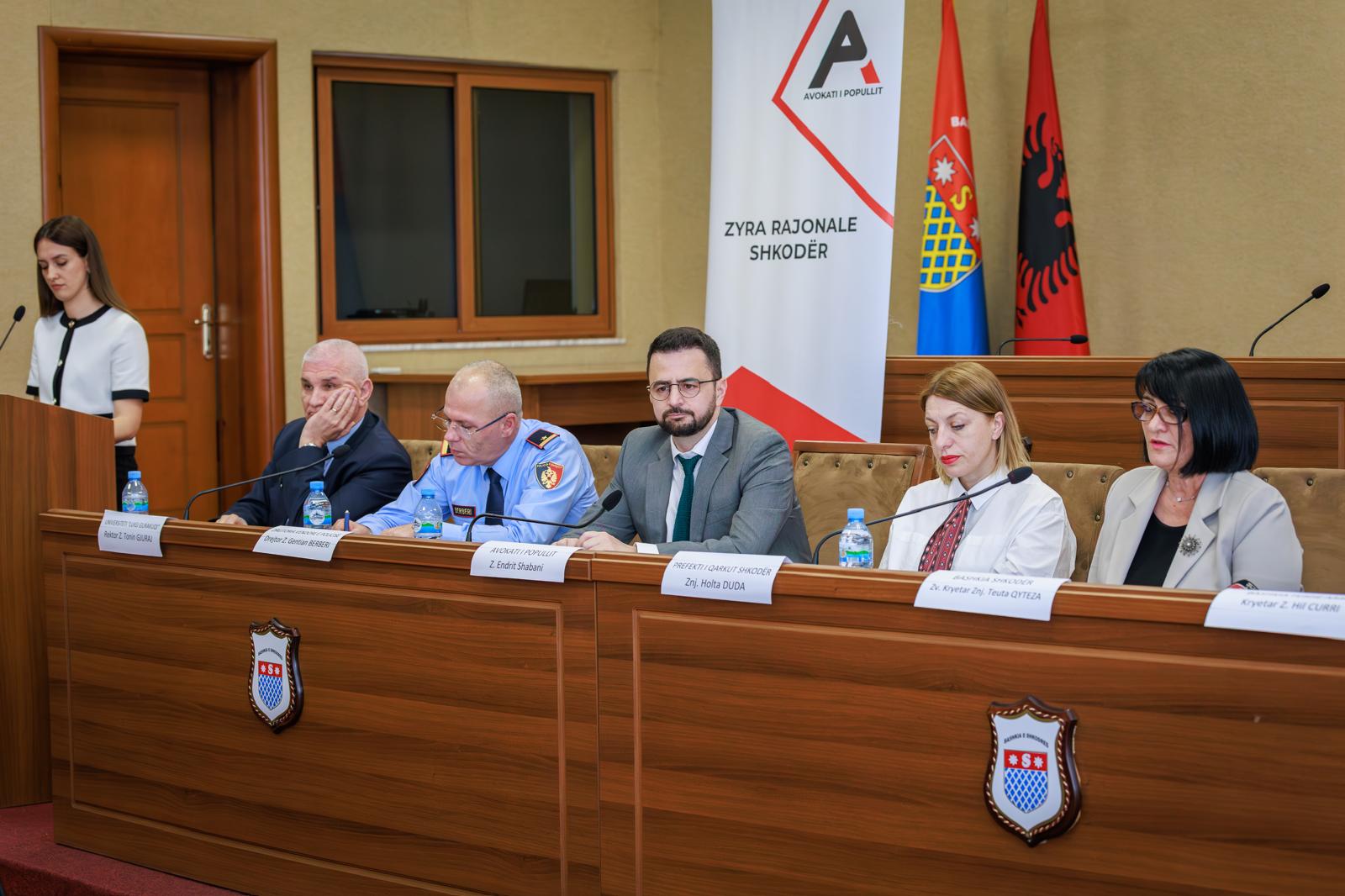
The People's Advocate, Endrit Shabani, declared today in Shkodra that guaranteeing the constitutional right to protest belongs only to the state and cannot be passed on to the private police. Referring to the recent events in Vlora and Shkodra, he emphasized that the monitoring of protests by private companies violates the very essence of constitutional rights.
“The private police operate within a legal framework for the security of private facilities, but public security is a constitutional obligation of the State Police and cannot be left to the private sector. If the protests are monitored by private police, we cannot guarantee constitutional rights. The private police should never be released from the monitoring of the State Police,” said Shabani.
The declaration was made during a dialogue forum that the People's Advocate organized in Shkodra between citizens, civil society, local government and regional leaders of public institutions.
After the welcoming remarks, citizens directly expressed their concerns to the leaders of institutions, demanding accountability for the services received or rights violated. Issues such as non-implementation of court decisions, property problems, missing investments in rural areas, lack of drinking water and electricity, and damage to cultural heritage were addressed.
Local leaders described the Ombudsman as a key partner in protecting citizens’ rights. The Prefect of Shkodra District, Holta Duda, emphasized that timely addressing of complaints should be the highest priority of institutions, while the Deputy Mayor of Shkodra Municipality, Teuta Qyteza, described the Ombudsman’s annual report as a measure of the work of local government.
"Citizens' trust does not always coincide with the level of reforms, as the final goal should be efficient and timely service. We must strengthen the culture of service, accountability and equal access. Addressing citizens' complaints in a timely manner should be the highest priority for institutions, regardless of the documentary burden", said Duda.
"It is unacceptable that a citizen does not receive a response to a protocolized request. The Ombudsman's report helps us reflect on what needs to be done better. For us, the citizen remains at the center and governance is measured by the ability not to exclude anyone, regardless of affiliation or community", said Qyteza.
The Rector of the University of Shkodra, Tonin Gjuraj, considered the dialogue between institutions and citizens as a democratic standard.
"Dialogue should be seen as a social and democratic expression that should be permanent between citizens and institutions at all levels. It should be part of our daily actions and not something imposed, but as part of education", - said Gjuraj.
The Forum was also joined by the Director of the Shkodra District Police, Gentian Berberi, who responded to the citizens' interest in security issues.
"The State Police has a continuous policy to raise standards, especially in the treatment of escorted persons. In Shkodra we have daily communication with citizens; Shkodra communicates, complains and requests, which we see as positive," - said Berberi.
In conclusion, Endrit Shabani thanked the citizens for their activation and all the leaders of the institutions present, emphasizing that the Ombudsman's investigations are not intended to criticize institutions, but to offer solutions to citizens.